CO₂ Laser Skin Resurfacing in Vancouver
Featuring the eCO2® 3D fractional CO₂ laser at Shine MD
At Shine MD, CO₂ laser resurfacing is approached through careful assessment and personalized treatment planning.
Our goal is to help you understand your options clearly while prioritizing safety, natural-looking results, and long-term skin health — whether you’re addressing acne scars, fine lines and wrinkles, uneven texture, or the visible signs of aging.
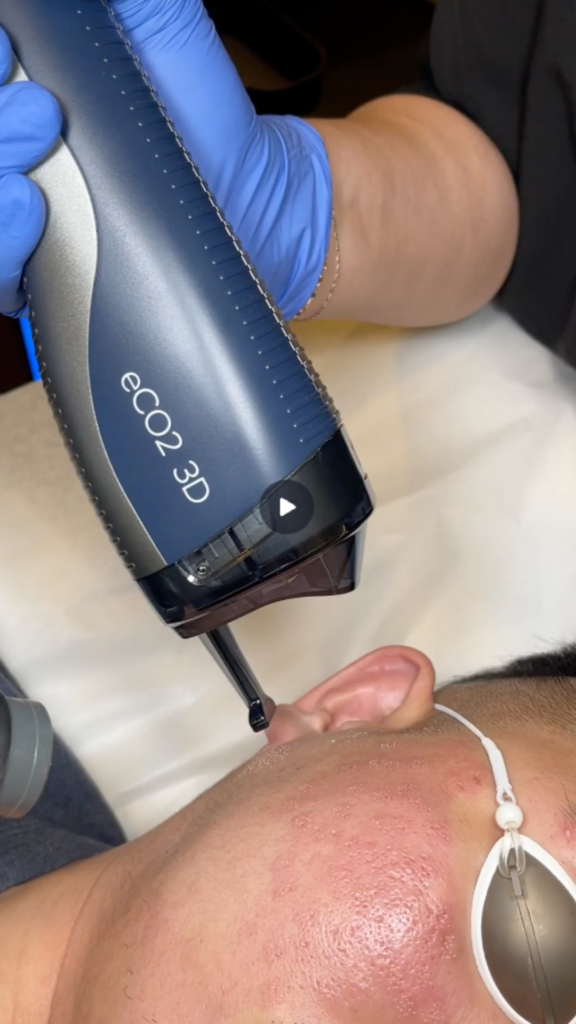
Dr. Mona Khurana has added the eCO2 3D by Cynosure Lutronic to Shine MD’s suite of advanced resurfacing technologies — a next-generation fractional CO₂ laser chosen for its versatility, precision, and its ability to be tailored thoughtfully across a wide range of skin tones.
What is CO₂ Laser Resurfacing?
CO₂ laser resurfacing is a treatment that uses precise beams of light to renew the skin’s surface and stimulate new collagen, improving acne scars, fine lines, wrinkles, uneven texture, and sun-related pigmentation.
A CO₂ (carbon dioxide) laser is an ablative laser, meaning it removes microscopic columns of aged, damaged skin while heating the deeper layers to trigger new collagen and elastin. As the skin heals, it’s replaced with smoother, firmer, more even-toned skin.
Fractional CO₂ lasers treat only a fraction of the skin’s surface at a time, leaving healthy tissue in between to speed healing which allows for meaningful results with far less downtime than the fully ablative CO₂ lasers of the past.
Ablative fractional CO₂ is widely regarded in the dermatology literature as a first-line, option for box car, ice pick and atrophic (depressed) acne scars, and it’s equally valued for wrinkles, sun damage, and overall skin renewal.
Because CO₂ is an ablative laser, it’s best suited to lighter skin types and is often a first-line choice for resurfacing certain scars; for darker skin tones we choose the Halo laser to improve skin texture.
At Shine MD, CO₂ laser resurfacing is performed with the eCO2 3D fractional CO₂ laser, which can be adjusted from a gentle, low-downtime Precision Peel to deeper resurfacing depending on your concern, skin type, and downtime tolerance.
Physician-Led Care from an acne and scarring expert
Led by Dr. Mona Khurana, MD, Shine MD provides physician-directed resurfacing for patients seeking personalized treatment for acne scars and positive aging plans. With a Postgraduate Diploma in Practical Dermatology and a particular clinical focus on acne, scarring, and skin of color, Dr. Khurana designs each plan around your skin type, goals, and long-term skin health.
Treatment planning at Shine MD is team-based and physician- led developed and supervised under Dr. Khurana’s direction, and carried out by experienced aesthetic providers with years of hands-on expertise on these technologies and within our practice.
Understanding your concern
Most patients who come to us about CO₂ resurfacing fall into one of two groups. The first is seeking facial rejuvenation — softening fine lines and wrinkles, firming mild skin laxity, and restoring smoother, more even texture as part of aging well.
The second is seeking treatment for acne scarring, where depressed scars linger long after the breakouts themselves have settled. Some patients bridge both.
CO₂ laser resurfacing can address many of these concerns with a single technology. A careful assessment is what makes resurfacing both effective and safe, including determining whether CO₂ is the right tool for your skin.
The eCO2 3D: Versatility in One Platform
Shine MD uses the eCO2 3D fractional CO₂ laser by Cynosure Lutronic — a modern system built around three depths, two modes, and one platform. In practical terms, that means Dr. Khurana and our team can tailor each treatment precisely to your skin:
- Interchangeable tip sizes (120, 300, and 500 microns) let us personalize the depth and density of each session — from fine surface refinement to deeper scar remodeling.
- Controlled Chaos™ scanning distributes energy in a randomized pattern for even coverage, fewer hot spots, greater comfort, and less downtime.
This flexibility is what allows a single device to serve two very different patients — someone wanting a subtle, low-downtime refresh and someone seeking dramatic correction of deeper scarring or wrinkles.
Ablative Resurfacing and Where the eCO2 3D Fits
Lasers are broadly grouped as ablative (removing the outer layers of skin to trigger renewal) or non-ablative (heating deeper layers while leaving the surface intact — less downtime, but more gradual results). CO₂ lasers, including the eCO2 3D, are ablative — that’s precisely what gives them their pronounced results on scars, wrinkles, and sun-damaged skin.
What makes the eCO2 3D versatile isn’t a switch between ablative and non-ablative — it’s the ability to work across the full depth of ablation, from a gentle, superficial Precision Peel with minimal downtime to deep, transformative resurfacing.
Adjustable tip sizes, density, and its two delivery modes — Static (“stamping”) for precise, targeted work and Dynamic (“air-brushing”) for smooth, even, full-face coverage — let us match the treatment to your goals and your tolerance for downtime rather than to a fixed setting.
What cO2 Laser Resurfacing Can Improve
The eCO2 3D is used for skin rejuvenation and resurfacing, and can be tailored to address:
- Acne scars — especially atrophic (boxcar, rolling, and ice pick) scars
- Fine lines and wrinkles
- Perioral rhytides — the vertical “lip lines” around the mouth that are notoriously resistant to other treatments
- Uneven skin texture and enlarged-looking pores
- Pigmentation and sun damage
- Surgical and other scars
- Skin firmness and collagen stimulation as part of aging well
For the broader picture of treating expression lines and dynamic wrinkles, see our fine lines and wrinkles page; for a full overview of rejuvenation options, visit our facial rejuvenation page.
How shine MD assesses your skin
Because resurfacing is so individual, every plan begins with a careful, physician-led assessment. We consider:
- Your skin type and skin tone — which shape device settings and pigmentation risk
- The concern being treated — scars, wrinkles, texture, pigment, or a combination
- The depth and pattern of scarring or lines
- Whether acne is still active — active breakouts are brought under control first
- Previous treatments and how your skin responded
- Your goals, timeline, downtime tolerance, and budget
CO2 Resurfacing for acne scarring
If you’re dealing with atrophic acne scarring — boxcar, rolling, or ice pick scars — fractional CO₂ resurfacing is one of the most effective tools available for improving skin texture.
In lighter skin types, it’s often a first-line choice for resurfacing certain atrophic scars. At Shine MD, the eCO2 3D delivers meaningful improvement in the smoothness and evenness of scarred skin, with results that continue to refine as collagen rebuilds.
Because CO₂ is ablative, we’re deliberate about skin tone: it’s best suited to lighter skin types, while for darker skin tones we typically favor safer, effective alternatives such as the Halo Laser.
True textural scars respond best to a layered, physician-led approach rather than any single device.
CO₂ resurfacing is often one component of our signature Shine MD Intensive Scar Repair Protocol (previously known as the Gold Standard), which may combine subcision with PRP to release tethered scars, biostimulation with Sculptra where volume is needed, and energy-based resurfacing such as CO₂, Halo, or radiofrequency microneedling — sequenced deliberately for your scar type and skin tone.
For a complete look at how we treat scarring, see our acne scarring page.
CO2 Resurfacing and Aging Well
Aging skin is not a problem to be fixed so much as a process to support thoughtfully. As collagen naturally declines, skin becomes thinner and less resilient, and fine lines, wrinkles, and a loss of firmness gradually appear. CO₂ resurfacing works with your skin’s own biology, stimulating fresh collagen and elastin to restore smoothness, tone, and a healthy glow.
The eCO2 3D is particularly valued for perioral rhytides — the fine vertical lines around the mouth that often resist injectables and lighter treatments. Its Static mode also provides surface firming through collagen remodeling.
For deeper skin laxity, we may recommend pairing your CO2 treatment with Quantum RF to improve your results. Your consultation will clarify which approach or combination best fits your goals. Your consultation will clarify which approach or combination best fits your goals.
What to expect during treatment
Your comfort is a priority. Before treatment, a member of our clinical team applies a topical anesthetic to numb the area, and you may choose nitrous oxide (Pro-Nox) or Penthrox for added comfort.
For aggressive treatments, your physician may inject numbing for you. During the procedure:
- You’ll feel warmth on the skin, and possibly a mild prickling sensation.
- The team carefully and uniformly treats the target area with the eCO2 3D handpiece.
- Treatment typically takes 30 to 60 minutes, depending on the area and approach.
How to Prepare
To support safe, effective results, we’ll give you personalized pre-treatment instructions. General guidance for skin-resurfacing procedures includes:
- 1 week before: Stop retinoids/retinols and exfoliating products (scrubs, AHAs/BHAs, peels).
- 1 month before: Avoid sun exposure and tanning beds, and use a broad-spectrum SPF 30+ daily.
- History of cold sores (HSV-1): Begin antiviral prophylaxis as prescribed to prevent an outbreak.
- Isotretinoin (Accutane): Isotretinoin (Accutane): Deeper resurfacing treatments are performed after an appropriate waiting period, which your care team will discuss with you individually. That timing depends partly on your isotretinoin dosing and the current condition of your skin.
Recovery, Downtime, and Aftercare
Your downtime depends on the intensity of your treatment.
Precision Peel (gentle): Minimal downtime — mild redness for roughly 6 to 48 hours, with many patients back to normal activity and makeup within a day or two. Safe in skin of color patients.
Deeper resurfacing: More attentive aftercare, with a typical recovery pattern of:
- Day 1: Skin feels warm and looks red
- Day 2: Mild swelling and peeling may begin
- Days 3–5: Continued healing and flaking as new skin surfaces
- Day 5–7: Redness subsides and fresh, rejuvenated skin emerges
Many patients return to work and social activities around day 5, and makeup can usually be worn once the skin barrier has recovered (about 5–7 days). Avoid sun exposure for 2–4 weeks, and avoid exercise, sweating, saunas, and hot tubs for 5–7 days.
Aftercare essentials: Gently cleanse morning and evening with a mild cleanser and blot (don’t scrub) dry; keep the area moisturized with the ointment your provider recommends; Once the skin barrier is intact (after about 48 hours), begin a broad-spectrum mineral sunscreen with zinc oxide or titanium dioxide.
Diligent sun protection afterward is essential. Detailed post care advice and support will be provided on treatment day.
Results and Timeline
As your skin heals over the following weeks, you can expect smoother texture, softened acne scars, refined pores, and a healthy, luminous finish. Because CO₂ resurfacing stimulates collagen remodeling, results continue to improve for months after treatment.
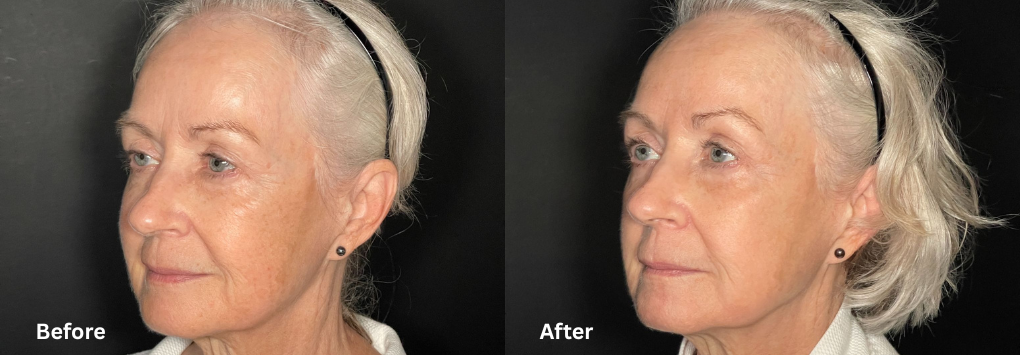
Individual results vary based on the concern being treated, skin type, treatment plan, and healing response.
In the dermatology literature, most patients treated with fractional CO₂ for acne scars experience roughly a 30–70% improvement in the appearance of their scars, with rolling scars tending to respond better than ice pick scars and higher-energy treatments producing greater improvement.
The number of sessions varies: gentler treatments are typically done in a series, while a single deeper session can produce pronounced results.
Skin Types and Skin-of-color considerations
Choosing the right resurfacing tool for your skin tone is one of the most important safety decisions we make and it’s an area where Dr. Khurana’s expertise in skin of color guides every recommendation.
Because CO₂ is an ablative laser, it carries a meaningful risk of post-inflammatory hyperpigmentation (PIH) in melanin-rich skin.
For that reason, CO₂ resurfacing with the eCO2 3D is best suited to lighter skin types (generally Fitzpatrick I–III), where it’s often a first-line choice for certain scars and textural concerns.
For darker skin tones, we generally do not recommend ablative CO₂ resurfacing — instead, we reach for our Halo Hybrid laser as a highly effective alternative that delivers real collagen and texture benefits with far lower pigmentation risk.
Those alternatives are a strength of our practice, not a consolation. For skin of color, we often add radiofrequency microneedling (Morpheus8 or Potenza), which is safe across skin types, along with gentler laser options such as Moxi and pigment-focused Aerolase — sequenced thoughtfully to improve scars, texture, and tone while protecting against unwanted pigment.
Knowing which tool suits which skin is central to how we care for skin of color. For more, see our treatments for skin of color.
who is a good candidate?
You may be a good candidate for CO₂ resurfacing if you:
- Have acne scars, fine lines, wrinkles, uneven texture, or sun damage
- Have a lighter skin type (CO₂ is best suited to Fitzpatrick I–III)
- Want smoother, firmer, more even-toned skin
- Understand that results vary and can follow aftercare instructions
- Have realistic expectations and want a personalized plan
CO₂ resurfacing isn’t right for everyone — darker skin tones, active infections, certain skin conditions, recent isotretinoin use, and other factors may mean a different approach is safer.
A consultation is the best way to confirm candidacy and, if CO₂ isn’t ideal for you, to explore gentler alternatives such as Moxi or Halo.
Why Choose Shine MD for cO2 resurfacing?
- Physician-led care directed by Dr. Mona Khurana, with treatment delivered by an experienced clinical team
- Acne and scarring expertise — a core clinical focus, informed by Dr. Khurana’s own experience
- Skin-of-color experience — thoughtful settings and pigment-risk management for richer skin tones
- Layered, multimodal planning — CO₂ used strategically alongside subcision, PRP, biostimulators, and RF microneedling when appropriate
- Advanced technology — the versatile eCO2 3D fractional CO₂ laser
- A safety-first, education-first approach in the heart of Vancouver
Discover Our
Before & After Gallery
Want to see real patient results from our innovative skin treatments? View our impressive before and after images in our photo gallery.
*Individual results may vary.
Frequently Asked Questions
Is CO₂ laser right for my skin tone?
CO₂ is an ablative laser, so it’s best suited to lighter skin types, where it’s often a first-line resurfacing choice. Because of the risk of post-inflammatory hyperpigmentation in darker skin tones, we generally recommend effective alternatives like Halo laser, RF microneedling (Morpheus8/Potenza), Moxi, and Aerolase. Precision peel can be performed in some skin of color patients. A consultation determines the safest, most effective approach for your skin.
How many sessions will I need?
It varies. Gentler Precision Peel treatments are typically done in a series, while a single deeper resurfacing session can deliver pronounced results. Your plan depends on your concern, skin type, and goals.
Is there downtime?
Downtime depends on intensity from minimal (mild redness for 6–48 hours with a Precision Peel) to about 5–7 days of redness and flaking with deeper resurfacing. Most patients return to normal activities around day 5.
Is it painful?
We prioritize comfort with topical numbing and the option of nitrous oxide (Pro-Nox). Most patients feel warmth and a mild prickling sensation during treatment.
Can CO₂ be combined with other treatments?
Yes. CO₂ resurfacing is often layered with subcision, PRP, Sculptra, or RF microneedling particularly within the Shine MD Intensive Scar Repair Protocol and sequenced for your skin. For positive aging plans, the CO2 can be combined with Qauntum Rf, Aerolase, PicoSure Pro and Broad Band Light Laser to address redness, pigmentation and texture all in one session.
When will I see results?
You’ll notice smoother texture and softened scarring as your skin heals over the first few weeks, with continued improvement over the following months as collagen rebuilds.
Do I need a referral, and what does a consultation cost?
No referral is needed for elective aesthetic treatments like CO₂ resurfacing. Consultation fees are $250 with a physician or $150 with a medical treatment provider.
Ready to Discuss cO2 resurfacing?
If you’re considering treatment for acne scars, wrinkles, texture, or aging skin, the best next step is a personalized consultation. Shine MD can assess your skin, explain your options, and build a plan designed around your goals, your skin tone, and your long-term skin health.