Acne Scarring Treatment in Vancouver
PHYSICIAN-LED CARE FOR ALL SKIN TYPES

At Shine MD, acne scarring is approached through careful, physician-led assessment and a personalized, multimodal treatment plan — not a single device or a one-size-fits-all package.
The goal is to remodel the skin safely and durably while protecting against pigment changes, with particular expertise in treating deeper skin tones.
The goal is safe, effective, confidence-building results for concerns like acne, acne scarring, and pigmentation, delivered through careful device selection and personalized planning.
Led by Dr. Mona Khurana, MD — who developed scarring acne herself and built Shine MD to provide the confident, skin-of-color–safe scar care she had hoped to find as a patient.
Acne scarring falls into three categories: redness (post-inflammatory erythema), pigment (post-inflammatory hyperpigmentation), and texture (indented or raised scars).
Redness and pigment are often very treatable and frequently reversible; textural scars are structural changes that respond best to layered treatments — most reliably subcision with PRP, followed by a resurfacing laser, optimized with a biostimulator such as Sculptra added.
The most important first step is getting any active acne under control. For skin of color, device and setting selection are chosen specifically to lower the risk of new pigmentation. At Shine MD, every plan is personalized to your scar type, skin tone, and goals.
Understanding Acne Scarring
If acne has left marks, discoloration, or changes in your skin’s texture, you’re not alone — and it’s reasonable to want help. Acne scarring can affect how you feel in your own skin, and research shows its emotional weight is real and often underestimated. Many people also worry, understandably, that treatment could make things worse — especially those with deeper skin tones who’ve been turned away or under-treated elsewhere.
The encouraging reality is that most acne scarring can be meaningfully improved with the right plan. But “the right plan” depends on correctly identifying what kind of scarring you have, because each type responds to a different approach. That careful, physician-led assessment is where good scar treatment begins.
What is Acne Scarring?
Acne scarring is the collection of marks and skin changes left behind after acne inflammation resolves. It’s helpful to think of it in three distinct categories, because they’re treated very differently — and most patients have a combination.
Acne itself is extremely common: it’s the most common skin condition in North America, affecting roughly 85% of people between the ages of 12 and 24, and often continuing into adulthood.¹ Its effects reach beyond the skin — people with acne and acne scarring are often perceived by others as less confident and less successful, and perceived stigma predicts psychological distress more strongly than acne severity alone.¹ Yet many people wait far longer than they need to before seeking care: in one study, 74% of patients had waited more than a year to seek medical attention for their acne.²
Not everyone who has acne will scar, and it’s difficult to predict who will. Risk is higher with more inflammatory or severe acne, recurring breakouts, delayed treatment, and individual healing tendencies. This is why treating acne early and effectively is the single most reliable way to prevent scarring in the first place.
Common Types of Acne Scars
Redness — Post-Inflammatory Erythema (PIE)
Pink-to-red marks left after a breakout settles, most common in lighter skin tones. This is a vascular change, not a true scar — there’s no structural damage — and it’s often very treatable with vascular-friendly light and laser treatments.
Dark Marks — Post-Inflammatory Hyperpigmentation (PIH)
Brown or grey-brown marks that linger after inflammation resolves, more common and longer-lasting in deeper skin tones. PIH is a pigment change rather than a true scar and is generally reversible with sun protection, pigment-focused skincare, and carefully selected lasers.
Texture — True Acne Scars
Permanent structural change in the skin, classified by shape:
- Boxcar — wider depressions with sharp edges
- Rolling (atrophic) — soft, wave-like depressions caused by fibrous bands tethering the skin from beneath
- Ice pick — narrow, deep, column-like pits
- Hypertrophic / keloid — raised scars from excess scar tissue, more common along the jawline, chest, and back
Textural scars don’t resolve with skincare alone; they respond best to procedures that physically remodel the skin — usually a combination of them.
How Shine MD Assesses Your Acne Scarring
Because scarring is so individual, every plan begins with a careful, physician-led assessment. Dr. Khurana considers:
- The type(s) of scarring present — redness, pigment, texture, or (most often) a mix
- Your skin type and skin tone — which shapes device selection and pigmentation risk
- Whether acne is still active — ongoing breakouts create new scars
- The depth and pattern of textural scarring
- Previous treatments and how your skin responded
- Your goals and which concerns matter most to you
- Your downtime tolerance, timeline, and budget
Because two patients with similar-looking skin can need very different plans, this assessment — not a fixed package, is what drives the recommendation.
Treatment Approach and Options
At Shine MD, we are dedicated to creating a comfortable, inclusive space for our patients to receive medical-grade acne care. Our physicians are General Practitioners with a Special Interest in dermatology, and they offer comprehensive treatment plans for acne and acne scarring, as well as other aesthetic and dermatological concerns.
Acne and acne scarring are treated together at Shine MD, not in a rigid sequence. Everyday acne management runs alongside scar care, though active breakouts are brought under control before an intensive scar repair regimen begins, so new lesions don’t undo the results.
Treatment plans are based on your consultation with your care provider, and are tailored to your specific goals, budget and tolerance for treatments.
Depending on your scarring, a plan may include:
The Shine MD Intensive Scar Repair Protocol
For moderate-to-severe textural scarring, our signature approach — the Shine MD Intensive Scar Repair Protocol (previously known as the Gold Standard) — layers complementary treatments in a deliberate sequence: subcision with PRP to release tethered scars, biostimulation with Sculptra where volume is needed, then energy-based resurfacing such as Halo, CO2, ProFractional, or radiofrequency microneedling.
Releasing tethered scars before resurfacing tends to produce stronger, more durable results than any single treatment alone — an approach supported by clinical evidence showing that adding PRP to subcision improves outcomes in atrophic acne scars.
How Acne Is Treated
Effective care pairs medical management with tailored skin treatments that match your acne type, skin tone and goals. Medical assessment of acne is covered by BC's Medical Services Plan (MSP) with a referral.
Topical treatments
Where most acne care begins.
Oral (systemic) treatments
Added for inflammatory or resistant acne.
Isotretinoin (Accutane)
The only acne treatment that works directly on the oil glands — shrinking them and reducing oil production, so improvement often lasts long after the course ends. Prescribed only when it's genuinely the right tool, with honest information and support throughout.
What to Expect During Treatment
Your comfort is planned for. Depending on the treatment, this may include topical numbing, local anesthetic for subcision, and measures to ease anxiety.
Many of our combination treatments are designed to accomplish several steps in a single visit, and your team explains each step before it happens. Most sessions are completed in-clinic without the need for general anesthesia.
Recovery, Downtime, and Aftercare
Downtime varies by treatment intensity. Pigment-focused skincare and gentle light treatments involve little to none; more aggressive resurfacing and the Intensive Scar Repair Protocol typically involve about 5–7 days of redness, swelling, or peeling.
Diligent sun avoidance and daily sun protection are essential throughout — especially for skin of color, where sun exposure can drive new pigmentation. Your team will provide specific aftercare guidance and let you know when to contact the clinic.
Results
Results are progressive and gradual. Redness and pigment may improve over a handful of sessions; significant textural correction is usually a series of treatments spanning several months to a year. Many patients repeat all or part of the Intensive Scar Repair Protocol over time, based on scar severity, downtime tolerance, and goals.
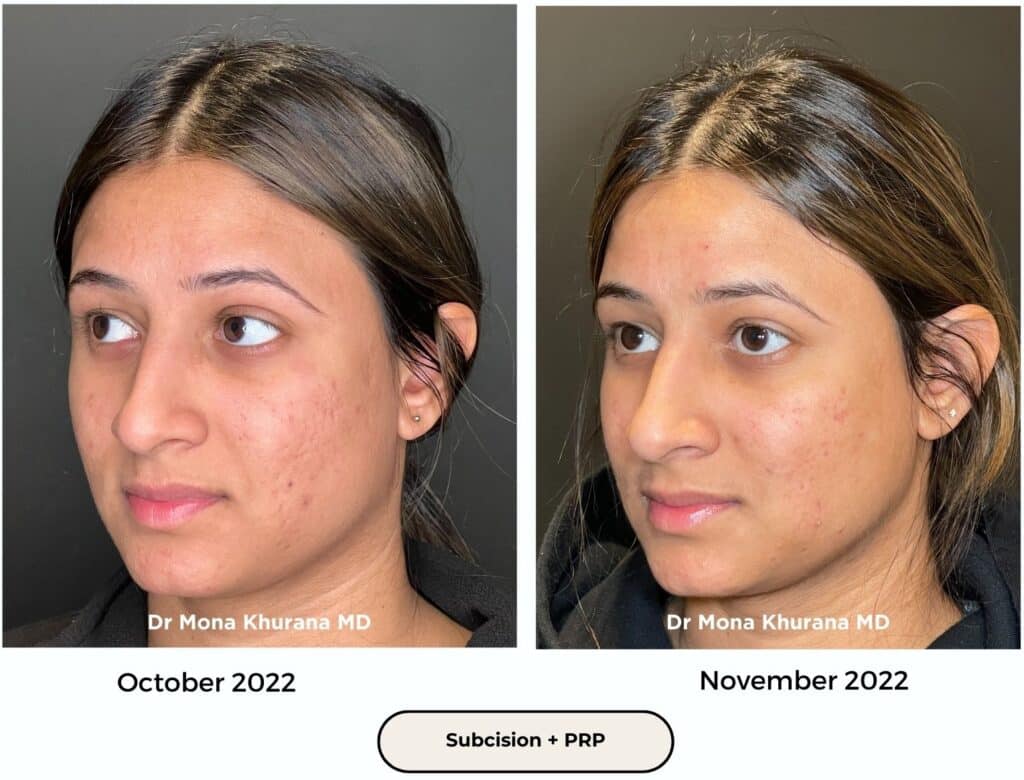
Individual results vary based on the scarring being treated, skin type, the treatment plan, and your healing response.
Skin Type and Skin-of-Color Considerations
For patients with deeper skin tones, scarring carries an added consideration: pigment. Post-inflammatory hyperpigmentation develops in up to 65% of patients with darker skin tones after acne, and it often lingers far longer than the acne itself.⁴ The wrong laser or setting can worsen pigment rather than improve it — which is precisely why device and setting selection matter so much here.
This is the heart of Shine MD’s practice. Over years of practice and investment in a broad range of devices — including Aerolase, Moxi, Halo, and PicoSure Pro — we’ve learned to match each patient with the treatment best suited to their skin, managing concerns like PIH with confidence. Explore treatment for skin of color and our approach to melasma.
Who Is a Good Candidate?
Acne scarring treatment may be right for you if you:
- Have textural scars, pigment, or redness left behind by acne
- Have active acne controlled, or are willing to address it as part of the plan
- Understand that results are gradual and usually require a series of treatments
- Can follow aftercare instructions, including sun protection
- Want a personalized plan built around your skin type and goals
- Have realistic expectations
Acne scarring treatment isn’t right for everyone or every scar in the same way, and a consultation is the only way to confirm what’s appropriate for your skin.
Why Choose Shine MD for Acne Scarring
- Physician-led care, delivered by an experienced team — Dr. Khurana sets the clinical direction and performs complex procedures like subcision, with a skilled team coordinating your care
- Genuine skin-of-color expertise — built into device and setting selection
- Integrated medical and aesthetic care — acne control and scar treatment coordinated in one place
- A refined signature protocol — the Intensive Scar Repair Protocol, developed in-house and grounded in evidence
- Honest, realistic counselling — no hype, no pressure, no promises we can’t keep
- Postgraduate Diploma in Practical Dermatology, with ongoing advanced laser and resurfacing training
From the Founder: Why We’re So Committed to Acne Scarring
My commitment to acne and acne scarring grew from my own experience and from having skin of color.
I developed severe scarring acne at 31, during my residency, and completed an eight-month course of isotretinoin. Even afterward, mild acne continued through my thirties, each lesion leaving new texture and pigment behind.
At 42, I finally decided to treat my skin and was disappointed that I couldn’t get a clear answer about which treatment was safest for my South Asian skin, or find a clinic that felt fully confident treating it.
A single hybrid laser treatment changed that: it improved both pigment and texture, safely, with no collateral damage — and it became the first device I chose for Shine MD. That experience is why this clinic exists — to be the confident, knowledgeable, skin-of-color–safe space I couldn’t find as a patient.
— Dr. Mona Khurana, MD
Discover Our
Before & After Gallery
Want to see real patient results from our innovative skin treatments? View our impressive before and after images in our photo gallery.
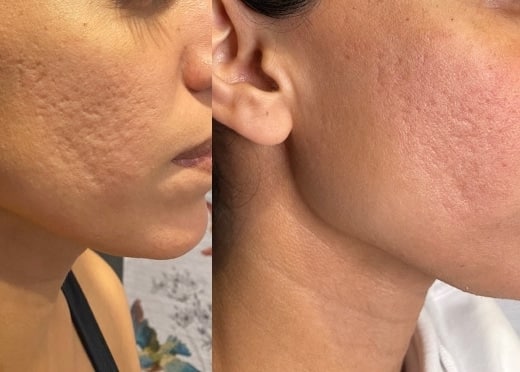
*Individual results may vary.
Frequently Asked Questions
What is acne scarring?
Acne scarring is the marks and skin changes left after acne inflammation resolves. It falls into three types: redness (post-inflammatory erythema), dark marks (post-inflammatory hyperpigmentation), and true textural scars (boxcar, rolling, ice pick, or raised). Most patients have a combination.
How do I know if I’m a good candidate?
The first step is identifying your scar type accurately, which requires a physician-led assessment of your scarring, skin tone, history, and goals. A consultation confirms what’s appropriate for your skin.
Is acne scar treatment safe for darker skin tones?
Yes — with the right approach. The key is choosing devices and settings that minimize the risk of post-inflammatory hyperpigmentation, which is exactly what Shine MD’s practice is built around.
Can I treat acne scars while I still have active acne?
Active acne is managed as part of the plan, since ongoing breakouts create new scars. Everyday acne control and certain scar treatments can often run together under physician supervision, though intensive scar work is timed for when breakouts are controlled.
How many sessions will I need?
It varies. Redness and pigment may improve over a handful of sessions; significant textural scarring is typically a series of treatments over several months to a year. Your plan sets realistic expectations up front.
Is there downtime?
It depends on the treatment: little to none for gentle light and pigment-focused treatments, and around 5–7 days for more aggressive resurfacing and the Intensive Scar Repair Protocol.
Do I have to wait six months after Accutane for laser treatment?
Not routinely. In 2017, the American Society for Dermatologic Surgery published a consensus statement establishing the safety of combining nonablative lasers and energy devices with isotretinoin.⁵ We assess each patient individually.
Can acne scar treatments be combined?
Yes — combining treatments is often what produces the best results. Releasing tethered scars with subcision before resurfacing, for example, tends to outperform any single treatment alone.
Do I need a referral?
Aesthetic scar treatments are elective and don’t require a referral. Medical management of active acne is covered by MSP and does require one. See our MSP referral information.
The Bottom Line
The best approach to acne scarring depends on your scar type, skin tone, treatment history, and goals — not on any single device or trend. Redness and pigment are often very treatable; textural scars respond best to layered, physician-led care.
And for every skin tone, getting active acne under control is the foundation everything else is built on. At Shine MD, every plan is personalized, with particular care for skin of color.
Ready to Discuss Acne Scarring?
If you’re considering treatment for acne scarring, the best next step is a personalized consultation. Shine MD can assess your skin, understand your goals, and recommend an approach designed around your needs, safety, and long-term skin health.