Understanding Acne: Causes, Types, and Grades
Medically reviewed by Dr. Mona Khurana, MD — Postgraduate Diploma in Practical Dermatology
Last reviewed: July 2026 · Read Dr. Khurana’s profile →
Dr. Mona Khurana and the Shine MD team established the Acne Clinic to offer full-service treatment plans for acne and acne scarring. Since 2020, our clinic has become a leading destination for advanced acne care, safe for all skin types.
Acne is a common, treatable skin condition that develops when pores become clogged with oil (sebum) and dead skin cells, creating an environment where bacteria grow and inflammation builds. It ranges from non-inflamed blackheads and whiteheads to deeper, inflamed papules, pustules, nodules, and cysts. Identifying your acne type and severity is the first step toward choosing the right care. Acne responds well to a thoughtful, physician-guided plan.
Discover the Shine MD Intensive Acne Scar Repair Protocol
Learn how Shine MD combines personalized scar assessment, foundation repair and advanced resurfacing treatments to address different acne scar types and skin tones.
What is Acne?
Acne is one of the most common skin conditions in the world — the eighth most prevalent globally, affecting an estimated 9.4% of people across all ages and anywhere from about a third to nearly all adolescents at some point. It is important to remember that acne is treatable and patients have options.
It begins in the hair follicle. Each follicle is paired with a small oil gland that produces sebum, the substance that keeps skin supple. When sebum and dead skin cells accumulate faster than the pore can clear them, the follicle becomes blocked. That blocked, oil-rich environment lets a normal skin bacterium, Cutibacterium acnes, multiply, and the immune system responds with inflammation.
What causes acne?
Acne rarely has a single cause. It’s usually a combination of factors working together, and understanding yours helps shape the right approach:
- Genetics. A family history of acne is one of the strongest predictors — studies put the association at roughly three times the likelihood when a parent has had acne.
- Hormones. Androgens increase sebum production, which is why acne often begins in puberty and can flare with the menstrual cycle, pregnancy, or conditions like PCOS.
- Skin cell turnover. Blocked pores create an environment where bacteria and inflammation develop.
- Everyday factors. Certain medications, some skincare and cosmetic products, friction from masks or equipment, and individual differences in skin all play a role.
It’s worth clearing up two persistent myths: acne is not caused by poor hygiene, and no single food has been shown to cause it.
Types of acne
Acne is variable from patient to patient and from day to day.
Non-inflammatory (comedonal) acne — clogged pores without much redness or tenderness:
- Blackheads (open comedones) — the pore stays open, and the surface darkens as it’s exposed to air.
- Whiteheads (closed comedones) — the pore is closed over, leaving a small skin-coloured bump.
Inflammatory acne — where the immune response is involved:
- Papules — small, raised, tender red bumps.
- Pustules — similar, with a visible white or yellow centre.
- Nodules — larger, firm, painful lesions deeper in the skin.
- Cysts — the deepest and most inflamed, soft and fluid-filled.
Most people have a mix. Nodular and cystic acne are the types most likely to affect deeper layers of skin, which is why earlier, proactive care matters for them.
Adult acne
Acne isn’t only a teenage condition. It commonly continues into — or first appears in — adulthood, and it’s more prevalent in women than in men, a gap that’s most noticeable in the adult years. Adult acne often looks different, tending toward tender lesions along the lower face, jawline, and neck, and it’s frequently linked to hormonal patterns. If your acne started or persisted well past your teens, it is considered a chronic skin condition and may require more definitive intervention like isotretinoin.
Hormonal acne
“Hormonal acne” isn’t a separate disease — it’s acne strongly driven by the effect of androgen hormones on the oil glands. It’s especially common in adult women; roughly 15–20% experience acne, and hormones are often at the centre of it.
How to recognize it
Hormonal acne tends to follow a pattern:
- Lesions concentrated on the lower face — jawline, chin, and neck
- Deeper, tender, cyst-like bumps rather than surface whiteheads
- Flares that track with the menstrual cycle, often the week before a period
- Acne that appears or persists well past the teenage years
- Oily skin
What’s behind it?
Androgens — like testosterone, which everybody makes in small amounts — stimulate the oil glands. Hormonal acne can involve elevated androgen levels, increased sensitivity of the oil glands to normal androgen levels, or both. This is why many women with clearly hormonal acne have completely normal blood tests. When levels are elevated, the most common underlying cause is polycystic ovary syndrome (PCOS).
When to look deeper
If hormonal acne comes with other signs — irregular periods, excess hair growth on the face or body, or scalp hair thinning — your physician may recommend checking hormone levels and evaluating for PCOS.
How it’s treated
Because it’s hormone-driven, this acne often responds especially well to treatments that target that pathway — options a physician might consider include combined oral contraceptive pills, spironolactone (an anti-androgen with strong recent trial evidence in adult women), and the topical anti-androgen clascoterone, usually alongside standard acne care. Where PCOS or insulin resistance is involved, addressing that helps too. Medical assessment for hormonal acne is covered by MSP with a referral; to discuss which approach fits your skin, visit our Acne Clinic.
Acne and skin of color
In deeper skin tones, the inflammation from acne is more likely to leave lasting pigmentation and uneven skin tone after a lesion heals — often the concern that lingers longest. This is why early intervention matters: to minimize and manage the pigmentation that gets left behind from acne. Shine MD’s team has a particular focus on safe, effective care for skin of color — you can read more on our Treatment for Skin of Color page.
How acne severity is graded
Alongside type, clinicians consider severity, usually described as mild, moderate, or severe based on how many lesions are present, how inflamed they are, and how much of the face or body is involved. Acne is considered severe if it impacts your social life or mental health. It guides how intensive a plan needs to be and how closely it should be supervised. All acne benefits from medical management.
How acne is treated
Acne is highly treatable, and modern care can address it in every skin type. Effective plans usually pair medical management with supportive in-clinic treatments and a tailored skincare routine, matched to your acne type, skin tone, and goals — with a physician providing medical leadership and oversight throughout. Medical assessment of acne is also covered by BC’s Medical Services Plan (MSP) with a referral.
Effective acne care combines multiple treatments and medication classes and takes your skin type and previous experience into account. We have summarized this for you in a table, but keep reading to learn more about the different acne medications and how they work.
How Acne Is Treated
Effective care pairs medical management with tailored skin treatments that match your acne type, skin tone and goals. Medical assessment of acne is covered by BC's Medical Services Plan (MSP) with a referral.
Topical treatments
Where most acne care begins.
Oral (systemic) treatments
Added for inflammatory or resistant acne.
Isotretinoin (Accutane)
The only acne treatment that works directly on the oil glands — shrinking them and reducing oil production, so improvement often lasts long after the course ends. Prescribed only when it's genuinely the right tool, with honest information and support throughout.
Regular vs. low-dose doxycycline: an important distinction
Doxycycline is one of the most commonly prescribed oral treatments for acne — but not all doxycycline works the same way, and the difference matters. Doxycycline is a highly effective intervention in treating acne and rosacea.
Conventional (antibiotic-dose) doxycycline, typically 100 mg daily, works partly by killing acne-associated bacteria and partly by calming inflammation. It’s effective, but because it acts as a true antibiotic, it can contribute to antibiotic resistance and disrupt the body’s normal bacteria. At this dose it is only used for three months at a time.
Low-dose, modified-release doxycycline (40 mg) works differently. This formulation — 30 mg immediate-release plus 10 mg delayed-release — delivers a sub-antimicrobial dose: too low to act as an antibiotic, but enough to deliver doxycycline’s anti-inflammatory benefit. In practice, that means it can reduce inflammatory acne without meaningfully driving antibiotic resistance or disrupting normal bacteria. In controlled studies, 40 mg modified-release doxycycline reduced inflammatory lesions comparably to the 100 mg antibiotic dose, but with fewer side effects, and without the resistance concern — which also makes it better suited to longer-term or maintenance use. (In Canada this low-dose formulation is sold as Apprilon.)
If the physicians at Shine MD recommend antibiotics for your care, the low-dose option will be their first choice for all the reasons above.
Isotretinoin: what’s true, what’s myth, and when a course is complete
Isotretinoin (still widely known by the original brand name Accutane) is the most effective treatment available for recurrent, severe, or scarring acne, and for acne that’s taking a real toll on quality of life. It’s a powerful medication that deserves both respect and accurate information — and it’s surrounded by more myths than almost any drug in dermatology.
Why we recommend isotretinoin — honestly
When we suggest isotretinoin, it’s for one reason: in most patients, it is the most dependable way to bring significant acne under control, with results that are typically lasting. It has decades of evidence behind it, and for severe, scarring, or stubborn acne, nothing else works as reliably.
Just as importantly, we have no financial incentive to prescribe it. When it comes up in your plan, it’s because it’s genuinely the right tool for your skin, and for no other reason. A great deal of our work in acne management is centered around increasing comfort in taking this medication: separating fact from the many myths that surround it, and making sure you feel informed and confident in your decision.
This reflects how we think about acne care overall. Skin quality improves most reliably — and most progressively — when acne is properly controlled through medical management, and isotretinoin in particular can create that stable foundation. Clearing active disease first means everything that follows, from smoother texture to any aesthetic refinement, is building on healthier, more predictable skin. Medical management isn’t a detour on the way to good skin; for most patients, it’s the most dependable path to it.
What the evidence actually shows
- Mood and mental health. The concern that isotretinoin causes depression is one many patients have heard, and it’s taken seriously. But large studies and systematic reviews have not established that isotretinoin causes depression or suicide. It is well documented that severe acne itself is associated with depression and reduced quality of life, often before any treatment begins and that clearing the acne frequently improves mood. The responsible approach isn’t avoidance; it’s open conversation and monitoring of mental health before, during, and after treatment, particularly for anyone with a personal history. If you’ve ever struggled with your mood, that’s important to share with your physician — not a reason you can’t be treated, but something to monitor together. It is very rare for patients to become depressed on isotretinoin. In fact, patients with mental health issues related to their acne often find their mood improves as their acne settles down.
- Inflammatory bowel disease. Despite early concern, large controlled studies have not confirmed a causal link between isotretinoin and inflammatory bowel disease.
- Laser and skin treatments don’t need to be delayed. The long-standing rule that lasers aren’t safe while on isotretinoin has been retired. Current dermatologic-surgery consensus supports proceeding with many procedures — including superficial resurfacing, non-ablative lasers, and microneedling — without the old mandatory waiting period, so acne clearance and scar treatment can be coordinated under our care. The team at Shine MD is very experienced in this area and will never put your skin at risk. You can continue to work on your goals while on isotretinoin.
- It’s highly effective, but acne can come back. Most people enjoy long-lasting or permanent clearance, but roughly one in five may relapse and benefit from a second course. For patients with chronic, recurrent adult acne, this is considered a chronic skin condition and may require ongoing treatment.
A planned part of every course: pregnancy prevention
Isotretinoin isn’t safe to take during pregnancy, so preventing pregnancy is built into every treatment plan from the start — a routine, well-established part of care rather than an afterthought. For patients who could become pregnant and are sexually active, reliable birth control needs to be in place before and throughout treatment, along with routine pregnancy testing. Your physician sets this up with you as a normal first step, and it’s something we manage together for the whole course.
How isotretinoin is dosed
What it’s actually doing
Isotretinoin is the only acne treatment that works directly on the oil glands themselves. It shrinks the sebaceous (oil) glands and dials down oil production — by prompting the oil-producing cells to switch off and reduce in number — which removes the environment acne needs to form. Because it remodels the glands rather than just suppressing symptoms, the improvement often lasts long after the course is finished. That’s why it’s the most dependable route to lasting control.
How we dose it
The usual target is around 1 mg per kilogram of body weight per day — but we rarely start there. Most patients begin lower and build up gradually. Starting slow eases the temporary flare, or “purge,” that some people notice early on, and lets us find the dose your skin tolerates comfortably. To keep the early weeks smooth, isotretinoin can be paired with an antihistamine, and in more aggressive, severe acne a short course of an oral steroid (prednisone) may be added at the start to keep inflammation calm. Dosing is guided by how you tolerate the medication and by your goals — which in turn shapes how long treatment takes.
What most patients find
Most people are pleasantly surprised by how manageable isotretinoin is. Once they’re comfortable, they move up to their daily target and reach their overall goal more efficiently. In general, a full course runs somewhere between 6 and 12 months — and it’s your choice throughout, so you can stop at any time.
High dose vs. low dose — what the evidence says
The key insight from the research is that long-term clearance depends on reaching a sufficient total (“cumulative”) dose over the whole course, not on how high the daily dose is. Low, moderate, and higher daily doses achieve similar long-term results as long as they arrive at the same cumulative total.
A higher cumulative dose does lower the chance of relapse — but only up to a point, beyond which more offers no added benefit. Practically, that’s reassuring: your daily dose can be tailored to your tolerance and goals without sacrificing how durable the result is.
That said, if your acne isn’t coming under adequate control within a reasonable time, a higher dose may be needed to get you to clearance — so the plan stays flexible and responds to how your skin is actually doing. Some patients still relapse and require ongoing management.
When is a course “done”? How long will I be on it?
Rather than a fixed number of weeks, isotretinoin is typically guided to an individualized endpoint — historically a target cumulative dose (often in the range of 120–150 mg per kilogram of body weight over the course), combined with clinical clearance and how your skin is responding. Your physician tracks progress and bloodwork along the way and determines completion based on your response, not a calendar. This individualized approach is part of why isotretinoin is best managed under experienced physician supervision.
Which isotretinoin? The options in Canada
All isotretinoin contains the same active medication — the differences between products come down to formulation, and specifically how reliably the drug is absorbed. Historically that has depended heavily on taking the capsule with a fatty meal, which can double absorption compared with an empty stomach. Newer formulations were designed to reduce that dependence. Four names are commonly referenced in Canada:
- Absorica LD — the newest option and the only micronized formulation, meaning the drug particles are physically made smaller for better uptake. It has the strongest absorption of the group, including on an empty stomach, so it’s the least dependent on being taken with food. Its improved absorption can also allow a lower overall (“cumulative”) dose to reach the same result.
- Epuris — built on Lidose technology, which pre-dissolves the isotretinoin in a lipid carrier to improve uptake. It offers the next-best absorption in a fasted state, and is likewise less food-dependent than the older formulations.
- Clarus — a standard generic isotretinoin. It’s effective and widely used, and is absorbed best when taken with a fatty meal, as the original formulations were designed to be.
- Accutane — the original brand from Roche that made isotretinoin a household name.
To see the full range of physician-led options and how a plan comes together
When acne leaves scarring
When inflamed acne affects the deeper layers of skin, it can change the skin’s texture as it heals, leaving atrophic (depressed) or, less often, raised scars. Treating active acne early and effectively is the best way to reduce this risk.
For patients with textural acne scarring, we have extensive experience and advanced approaches to treating acne and acne scarring at the same time.
Acne myths and facts
- Acne means your skin isn’t clean. Fact: acne is driven by follicle biology, hormones, and genetics — not dirt.
- You should just wait to grow out of it. Fact: waiting lets inflammation, and sometimes permanent scarring, develop. Acne is highly treatable, so there’s rarely a reason to wait it out.
- Popping or picking speeds healing. Fact: it deepens inflammation and raises the risk of both scarring and lasting pigmentation, especially in deeper skin tones.
- Sun and tanning clear acne. Fact: any brief drying effect is outweighed by skin damage and worse pigmentation — and several acne medications increase sun sensitivity.
- Acne is only a teenage problem. Fact: it commonly continues into or begins in adulthood, and is especially common in women.
- Acne is just cosmetic. Fact: it carries a real, documented psychological weight and can scar — which is exactly why treating it early matters.
- Isotretinoin is a dangerous last resort. Fact: under physician supervision it’s one of the safest, most effective, and best-studied acne treatments there is.
Frequently Asked Questions
What is the main cause of acne?
There’s rarely just one. Acne forms when follicles clog with oil and dead skin cells and become inflamed, and that process is influenced by genetics, hormones, and individual skin factors more than by anything you did or didn’t do.
What are the different types of acne?
Non-inflammatory acne includes blackheads and whiteheads. Inflammatory acne includes papules, pustules, nodules, and cysts. Most people have a combination of acne types.
Is acne caused by poor hygiene?
No. Acne is driven by follicle biology, hormones, and genetics.
Does diet cause acne?
No single food causes acne. The overall pattern matters more than any one item — a Western diet high in sugar, refined carbohydrates, and dairy is the pattern most associated with breakouts, and chocolate’s reputation is likely down to the sugar and milk in it rather than the cocoa. Any effect is modest and varies from person to person, so diet is a possible aggravator, not a cause or a cure.
How do I know if my acne is hormonal?
Hormonal acne tends to sit on the lower face — jawline, chin, and neck — as deeper, tender bumps that flare with the menstrual cycle and persist past the teenage years. Many people with hormonal acne have normal hormone levels; if it comes with irregular periods or excess hair growth, it’s worth evaluating for PCOS.
Can adults get acne?
Yes. Acne commonly continues into or begins in adulthood, and it’s more common in women. Adult female acne often appears along the jawline and lower face and is frequently linked to hormones.
Does acne go away on its own?
Some mild acne settles over time, but waiting can allow inflammation and, in some cases, scarring to develop. Because acne is so treatable, there’s rarely a reason to simply wait it out.
Why does acne leave marks or scars?
Inflammation can leave pigmentation and uneven skin tone as it heals — more common in deeper skin tones — and deeper lesions can change skin texture. Treating active acne early is the best way to reduce both.
What are the treatment options for acne?
Options range from topical treatments — retinoids, benzoyl peroxide, topical antibiotics, clascoterone, azelaic acid — to oral treatments including antibiotics, hormonal therapy, and isotretinoin. Most effective plans combine treatments with different mechanisms, matched to your acne type and skin tone.
What’s the difference between regular and low-dose doxycycline?
Conventional doxycycline (around 100 mg) works as an antibiotic. Low-dose modified-release doxycycline (40 mg) delivers a sub-antimicrobial dose that reduces inflammation without acting as an antibiotic, so it doesn’t meaningfully drive antibiotic resistance — with comparable results and fewer side effects for suitable patients.
Does isotretinoin cause depression?
Large studies have not shown that isotretinoin causes depression, and clearing severe acne often improves mood. Mental health is still monitored before, during, and after treatment, and any history of mood concerns should be discussed with your physician.
Is acne care covered by MSP?
Medical assessment and management of acne is a covered benefit under BC’s Medical Services Plan with a referral from a family physician or walk-in clinic. Extended benefit plans through your employer will likely offer financial coverage for many commonly prescribed acne medications. Supportive treatments like facials, skincare, and some lasers are not covered.
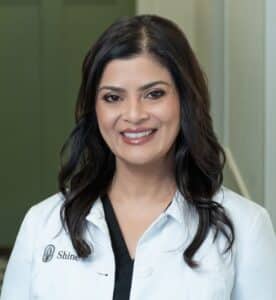
Dr. Mona Khurana, MD
Dr. Khurana is the founding physician of Shine MD Skin Care & Medical Aesthetics in Vancouver. She holds a Postgraduate Diploma in Practical Dermatology (Cardiff) and focuses on the medical management of acne and acne scarring, with particular depth in treating skin of color. She is a Sciton Luminary and an Aerolase Ambassador, and a Cynosure Key Opinion Leader (KOL), and has worked with global pharmaceutical companies including Sun Pharma and Galderma to support physician education.